Tuesday, October 7, 2014

Gender Roles and Collectivistic Culture in Saudi Arabia - Harrison Moore

In order to effectively communicate with Saudi Arabian natives one must first understand their dynamics of the gender role. In Saudi Arabia, the woman is required to fully clothe herself in robes and also what is referred to as an "abaya", which is a thin, black outer cloak. The female is to also wear what is called a "shayla" which covers their entire head other than their eyes. Although Western culture views this as somewhat "degrading" and "constrictive", Saudi women believe that their wear is a sign of modesty and virtue and they generally view themselves as "protected and honored." Instead of rebelling against their cultural roles, they embrace them!


Male dress includes what is known as a "thawb", which is their typical ankle-length shirt that's usually made from cotton or wool. A large square of cotton (a ghutra) is worn atop of their heads that is folded over a skullcap (a kufiyyah) and is held in place with a cord circlet (an igaal). The outer length cloak, called a bisht, completes their outfit. This was also used in the older days of Saudi culture as a blanket while traveling.


In the Saudi Arabian culture the male dominates every aspect of life. Women are subservient to their male counterparts, requiring to essentially request permission over a majority of private and public business. Although women in Saudi Arabia are able to invest their own money, own a business, and own their own land, a close male relative or authority figure (referred to as a mahram) must always be present. In order for the women to make any sort of decision regarding her business or sign any legal documents, the mahram must be present for approval.

Women are also very restricted in which careers they can choose (if they even want to) and typically work in environments that heavily involve interaction with other females, since it is looked down upon for unrelated Saudi men and women to have interaction without male authority presence. Restriction of females in the job market also has to do with their inaccessibility to drive. Since legally you cannot cover your face while driving and to uphold Islamic beliefs, women are not allowed to drive. Females having access to individual transportation also poses that the female may feel inclined to leave the house more often, taking away from her typical household regulations. Also this provides possible unnecessary interaction between unrelated males (flat tire, car accident).
Only 7% of the professional Saudi workforce is female. Some examples of typical female positions are all-girls' schools/universities, social work and development for females, and banks that cater to only female clients. Usually in local markets and bizarres there are sections that are also set aside for female sellers.


Their collectivistic culture emphasizes equality and siblinghood, which derives from an important Islamic principle "Every individual should be honest and responsible to the group." Saudis typically use euphemisms and playful short stories to downplay unpleasant facts or news. Because every Saudi believes in preserving their integrity and also expects the same respect from others, non-contribution (especially in the workplace) could cause serious offence and shame. Being naturally very tight-knit, personal and professional interaction are extremely involved with each other. Work is slower paced because Saudis believe they can achieve things greater and faster if everyone is in harmony. Small talk is created before meetings in order to create rapport. This allows the group to understand the feelings and well-being of other members.
Although success is favorable, punctuality is really emphasized in the Saudi Arabian culture. They are very future-oriented in business endeavors, so even when success has been achieved (and praise has been given to the group) there is always a need for more improvement and to do bigger and better things, possibly even developing what they already succeeded in even further. There are not really any philosophies or slogans you see typical Western businesses have. The main purpose of their's is to just continue to grow in what you have.

Respect is a vital part of Saudi Arabian culture, so conducting oneself with respect and also respect to others and their beliefs can lead to many open doors in the professional world. This can drastically reduce any conflicts in communication and aversion to business collaboration which favors the outcome of successful professional relationships!

Business Etiquette & Power Distance In Saudi Arabia By: La Royce Browning

Within the country culture of Saudi Arabia there are several business etiquette's that must be followed upon entering in to the country.  First, you must be invited into the country and be accompanied by a Saudi sponsor which is called a wakeel upon entering.  The wakeel makes the arrangements for meetings with the appropriate people for you.  Making appointments are a must and should be made several weeks to a month in advance if at all possible.  If you were to schedule a meeting with a government official, your meeting would not be finalized until you arrived physically in the country.  Saudis like to have meetings in the morning and on time.  Although it is custom to keep foreigners waiting and not uncommon to have a meeting cancelled once you arrive.


Saudi Arabia


Saudis do not require a lot of personal space as some other cultures.  They tend to stand very close to you while you are in conversation and you may feel as though they are violating your personal space.  Their meetings are generally not private until after a trust relationship has been established and Saudis prefer to work with people that they know and trust.  This means that you may expect frequent interruptions.  Other people may wander in and out of the room to starting different conversations.  You may join in on the conversation but do not bring the topic back to the original discussions until the new person leaves.


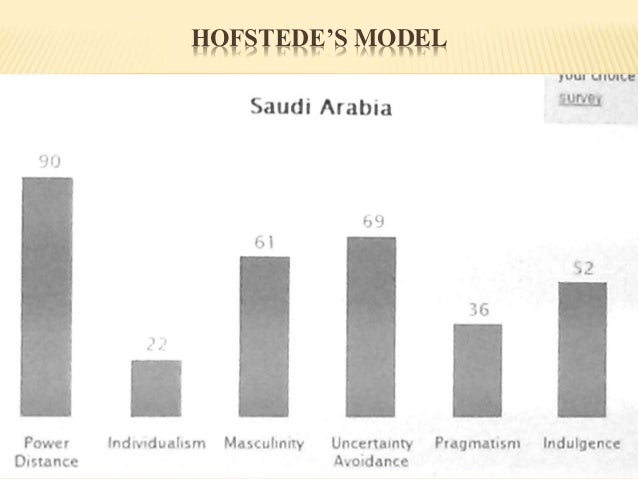
Power distance varies from culture to culture and in Saudi Arabia power distance is extremely high.  A brief definition of power distance is the extent to which the less powerful members of organizations and institutions accept and expect that power is distributed unequally.  Saudi Arabia has one of the highest ranking power distance in the world and one of the main reasons is religion.  If you are not Muslim you are not allowed to enter Saudi Arabia without invitation and exit with a permit.  The Islamic faith allows this power distance and even promotes people in superior positions without questions.  Muslims believe in the idea of power and unquestioned superiority based off of verses in the Koran.  Saudi Arabians believe that obeying your superiors and supporting your government is of the utmost importance which they accept as a part of their cultural heritage.

Due to the high power distance of Saudi Arabia has many inequalities with the most prominent one being unequal wealth distribution.  Some of the effects of the unequal distribution are things including a caste system that also inhibits upward mobility, stifling innovations and free thinking and less job opportunities.  Saudis have an expectation and acceptance that the leaders will separate themselves from the group and this condition is not necessarily subverted upon populations.  It is rather accepted by the society and laws are so strictly enforced that thieved can have their hands amputated and public beheadings are still held for capital punishment

Monday, October 6, 2014

Russia


High context or Low Context

by: Ja'Vante Mack


Russia is a high context culture that emphasizes all three dimensions of Attitudes, Behaviors, and Cognitions. In a high context culture, "everything matters". The society is very aware of components in the surrounding environment, including non-verbal, traditions, history, and relationships


In order to communicate effectively with people in other countries, it’s important to know the business hierarchy and how people relate to each other. One way to understand this is in terms of "high context" and "low context," a classification based on how people in different cultures communicate. High context refers to societies in which people have close connections. High-context people are generally defined as:

·        Less verbally explicit. Instead, they rely more on indirect verbal interaction and are proficient at reading non-verbal cues.

·        Having less written/formal communication. High-context cultures are more interested in fostering trust than in signing contracts.

·        Having strong boundaries. They have more clearly defined roles of authority, and differences in status are valued. They rarely call people by their first names.

·        Relationship-focused. Decisions and activities are focused around personal, face-to-face relationships.


Communication within the Russian business culture


Living in Russia as a foreigner is a unique experience. This country, full of contradictory images, can bring the best and, unfortunately, the worst. Working among Russian colleagues is an excellent opportunity to find out the true nature of this culture often perceived through biased stereotypes.
 
The behaviour of Russian employees and managers, once the first weeks of mutual observation and diplomatic gestures are over, becomes little by little bewildering at best, and possibly disturbing at worst. However, with a little curiosity and open-mindedness, the reality that appears may be highly instructive and useful for the rest of your stay.
 
A new field of business management can help in understanding the hidden layers of the Russian culture: cross-cultural management. Composed of a bit of anthropology, a bit of sociology and a lot of management theories, this new field helps understanding why the  culture is different.

Business Etiquette and Conflict in China

by Jamie Beer


Business etiquette in China is built around a deep respect for elders and rankings, as well as a heavy emphasis on building good personal relationships and maintaining a professional attitude. Almost all business is conducted with high consideration for who is wielding the most power and who will most benefit from the deals. The high regard for power distribution stems in part from China's Communist government and history of respect for the elderly and formal ranks.


The Chinese approach to business conflict is significantly different than the Western approach. Conflict in China tends to happen much less often than in the West, but with a much greater intensity when problems do arise. In the West, conflict is usually handled by figuring out who's at fault for causing the problems. In China, conflict is resolved not by assigning blame to individuals, but taking a more positive approach by figuring out a solution that provides the most benefit to both parties involved, with special consideration given, of course, to who's wielding the most power. This approach generally enables both sides to benefit and salvage the business relations, rather tearing the relations completely apart.


Given that short overview on the general Chinese business conduct, the best way to successfully conduct business with the Chinese and avoid creating conflict is to have a basic understanding of Chinese cultural practices. As was previously stated, business is very formal in China, so dressing professionally is an absolute must! Business attire must be modest, with neutral colors; casual dress does not have to be as formal but should still have an emphasis on modesty and professionalism. It's especially important to arrive on time for events, and care must be taken to give the proper respect due to someone's rank.
One should also work on developing good relations with the Chinese--having friends in China is perhaps one of the biggest assets possible to acquire when conducting business there, since they can help guide through tricky cultural hurdles and open up opportunities that might not otherwise be available. Becoming good friends with one's business partners also enables conflicts to be sorted out more quickly and easily--the Chinese will be more forgiving of accidental social blunders if they like you.
When at dinner parties, it's generally best to mimic what the host and the others are doing. Business conversation should be saved for later, and while it is acceptable to refuse food offered to you, it is rude to eat everything on your plate(this signals that there was an inadequate amount of food present). The traditional rule of trying a bit of everything is still in good manners though, although you do not have to finish the food that you do not like.
Gifts are also a good way to develop relations, but must be approached carefully to avoid insulting the Chinese. It is best to present gifts either privately, or in public to the leader of the whole group. Giving gifts to government officials should be avoided, since it is considered a bribe. Items resembling weapons, or items such as clocks, straw sandals, or anything that is black, white, blue, or has storks or cranes on it should be avoided--these last items the Chinese most often identify with death. The most ideal gifts are those that carry some sort of cultural significance from your local area back home.


All that being said, the two major keys to successful business in China is to remember the proper respect due to one's rank, and to make close friends. Conducting yourself professionally at all times and developing good relationships will open up many opportunities, help you avoid creating conflicts, and allow you to more easily resolve problems should they arise and achieve more favorable outcomes overall.


Sources Consulted and Further Information

http://www.tradecommissioner.gc.ca/eng/document.jsp?did=107932&cid=512&oid=32

http://chinasolved.com/2011/10/conflict-in-chinese-negotiation-the-basics/

http://www.cyborlink.com/besite/china.htm

http://www.businessforum-china.com/management_article_detail.html?articleid=337


Makenzie Stone - Russia


RUSSIA's
 Approach to Conflict  &
.
 General Business Etiquette 

~~~~~~~~~~~~~~~~~~~~~~~~~~~~~~~~~~~~~~~~~~~~~~~~~~~~~~~~~~~~~~~~~~~~~~~~~~~~~~~~~

Approach to Conflict:

When having a conflict in Russia the way it is approached really depends on where you are. For example, public manners outside of Moscow are much better than those inside of Moscow. 

Lets take the metro for instance. You better be ready to hold your own ground because people will literally push you on & off the train if you get in their way.


Even if you do manage to not get shoved around you make it to the store you will still feel very uncomfortable when ready to check out because being in a person's personal space in an understatement in the metro. It is not unusual to be waiting in line for something & have a person actually lean on you while they wait. 


This rudeness does not stop once it is finally your turn in line either. If a cashier or ticket attendant can not help you they will not politely tell you so. They will in fact shout "Nyet!" at you, which means "No" in Russian, & look at you like they did nothing wrong. 


Luckily, when it comes to high-quality restaurants & hotels the employee's manners are restored to what we would consider acceptable. 

~~~~~~~~~~~~~~~~~~~~~~~~~~~~~~~~~~~~~~~~~~~~~~~~~~~~~~~~~~~~~~~~~~~~~~~~~~~~~~~~~

General Business Etiquette:


The one rule that will always exist in your meetings & business relationships in Russia is that everything is based on personal relationships. Meaning that your background, your behavior, your professionalism, & your respect for local customs & norms will all factor in how you are initially perceived. So first impressions can either make or break you in Russia making the meeting & greeting aspect very important.

When meeting it is important to take off your gloves (if wearing them) before shaking hands.

Men shake hands with men. Women do not generally shake hands with other women but most Russian men do shake hands with women during initial introductions but not always. Also men usually stand up when someone enter the room but if it is a women they most definitely will.


When a Russian introduces themselves it is important to play close attention & listen for the person’s patronymic middle name. If they do not say it then look for it on their business card, which are usually in Russian on one side & in English on the other. This is because even though Russians do have equivalents for the English terms “Mr” and “Mrs” they are not commonly used.

Also, when asked “how are you” in Russia you are expected to give a genuine answer instead of just saying “Good. How are you?”.


Russians are very demonstrative people & public physical contact such as hugs, backslapping, & kisses on the cheeks are common between friends, colleagues, & members of the same sex. Also, when talking Russians stand very close to one another.

Hand gestures such as putting your thumb in-between your index finger & middle finger or making the “OK” sign are both considered very rude.
If doing any type of business in Russia it is important to know that “Business Casual” is a no go. Russians pay very close attention to their appearances & both men & women usually wear extremely expensive clothing. This is because they expect a serious businessperson to look formal & conservative.


Men should wear suits & ties. Women should wear suits, dresses, or pantsuits.
When it comes to the telephone Russian businesses run them quite differently then American business. If you are calling businesses in Russia it is not unusual to be shock by the very rude greeting given by the receptionist. When answering the phone they say (in Russian of course) “I’m listening to you”. There is not “Hello”, “How may I help you”, nothing. However it is not meant to be rude it is just how things are done there.

Also, people in Russia never turn their phones off or ignore a phone call. You can be sitting in a meeting & have someone answering their phone several times throughout. They also never cut short or rush any conversation on the phone. Again this is not meant to be rude it is just a general accepted practice of theirs. 


Friday, October 3, 2014

The Culture Shock of Conducting Business with the Chinese, written by Moe Skinner


How to Effectively Communicate in Business with the Chinese


     Working abroad can benefit one's career on numerous levels, but with the rewards also follows a great amount of understanding and adapting within that culture. I have researched information pertaining to the Chinese cultural differences in business practices in order to communicate effectively with potential Chinese business partners.
    
 Dutch social psychologist, and author of several publications on global culture, Gerard Hofstede designed a model to measure an individual country's tolerances, behaviors, and expectations in the work place.


(GERARD HOFSTEDE)


PHOTO FROM WEBSITE
    
  I will focus on two topics; power distance and uncertainty avoidance in China, and use measurements provided by Hofstede's model. I will define each topic, give brief examples of work place scenarios, and compare statistics between the United States and China.    

                                   Let's first define power distance:
 The degree in which a society recognizes and accepts that power is divided unequally.           

     Another words, how well do people concede and adapt to working for the hierarchy? Do they follow strict guide lines where creativity or self-expression is virtually mute? Or, are they free to propel their careers in to infinity with imagination & experimentation? The higher the PDI level, the less room for personal vision in the work place.


FLAGS FROM ACROSS THE WORLD


 Many cultures differ, and before you attempt to pursue a career in a foreign land you should first gain an overall view of the customs, behaviors; including verbal and non-verbal, and expectations of said country. 

Let's look at a graph that measures the Power Distance between the U.S. & China


    When we examine China's PDI rating of over 80, we can expect that rank is extremely important. Respect towards superiors in the work place is demanded.

   Unlike China, the U.S. has a PDI rating of just above 40.This number reflects a contrast to the working environment conditions Americans have grown a custom to. Employers and managers are often challenged by a worker's drive & performance.  

                                                   
                          In America, Respect is Earned and not Given!


     According to Dr. Matthew Earnhardt, author of; The Successful Expatriate Leader in China, in high PDI working environments, like China, the hierarchy demand respect as well as loyalty.
                                    
                          You can read Earnhardt's article on line @:
                                                         (PHOTO FROM WEBSITE)
     In China, there is a clear line that distinguishes superiors from the common worker. At the same time, the Chinese practice a tradition known as "Guanxi".
               http://www.worldlearnerchinese.com/content/what-guanxi

 This means by default of Chinese culture, the Chinese develop relationships and rationalize business decisions based on exchanging favors and connections that benefit all parties involved. The tradition also allows the blue-collar worker or subordinate employee to call upon superiors for assistance and the brass is expected to aid workers that rank beneath them.
             Chinese supervisors and managers ride a double edge sword. 

 BOSSES MUST                

  1.  ESTABLISH SUPREMACY                                           
  2.  MAINTAIN RESPECT FROM LOWER RANKS             
  3.  HAVE THE ANSWERS/ JUST ANSWERING WITH AN "I DON'T KNOW" LOSES RESPECT IN THE WORKPLACE
   < simultaneously > 

BOSSES MUST 
  1. BUILD RELATIONSHIPS
  2. SUBSCRIBE TO THE THEORY OF HELPING THE WORKER FOR THE COMPANY'S BENEFIT


Jasonkim29, blogger, on wordpress.com wrote about customs in Chinese business gatherings. 

For example, it is customary to seek out someone of higher rank and greet them first.


                                                                      (PHOTO FROM WEBSITE)

 If a meal is served, one must wait to eat until the hierarchy has begun to eat. 


  Now that we have a little insight about the traditions in power distance in the work place operations, let's take a look at uncertainty avoidance in both countries and give a definition and brief examples.  

 
HEADS OR TAILS

                  UNCERTAINTY AVOIDANCE: 
The extent in which people in a community feel uncomfortable or threatened with risky or questionable situations and the steps they take to avoid them. 


In cultures with high numbers in UAI, the population is apprehensive about the future. Their stress levels are higher, and change is abnormal. Due to these conditions, these cultures have strict rules for interacting socially. The Chinese government has stringent legislation to curb unacceptable social conduct. The Chinese are notorious for public executions. 


 The Chinese prefer to build relationships with companies they trust. 
                        
              Loyalty is a must!     Risk Taking is unacceptable!

                   
  One must prove competency as well as express devotion in the Chinese workplace before trust can start to build. Showing interest in building a bond with a Chinese business associate, will help establish a friendship, and will help to ensure future positive business ventures together.

Earnhardt described an uncomfortable work situation involving Heather, an expatriate HR manager for a U.S. company. She reported to her superior, Mr. Liu, a Chinese manager.  

Liu had qualities that exhibited high uncertainty avoidance. Liu would not give up control on projects because he didn't know Heather and didn't believe in her. In his eyes, placing Heather in control would have jeopardized the company. 

Heather didn't understand the cultural differences and didn't know the proper way to address the situation. She contacted headquarters and asked for their assistance in clarifying to Liu her duties and role in the work place. 

The hostile work place was created because of Heather's ignorance of the Chinese cultural traditions and beliefs abroad. Heather could have avoided the conflict by first researching Chinese cultures using Hofstede's models. With that information gained, Heather could have approached Liu in a way that would have been more beneficial to both.


On the flip side, in places where the UAI number is lower, people have a tendency to live a more passive lifestyle. Cultures easily adapt to change and risks are acceptable and often encouraged. In this culture competition is a given, standing out in good merit in beneficial, and, opposition to one's superiors is accepted.

In America, one can advance quite quickly in the work place. Several factors can come in play for this to happen, but none of them compare to the Chinese outline for advancement.

On the closing note, Jasonkim29 stresses the point of never visiting your Chinese partners empty handed. To impress your foreign colleagues, greet them with gifts such as wine and even cigarettes.